

Insights: Recent Trends in Technology
Latest Trends in Technology That Are Transforming Education, Business & Society
Technology is evolving faster than ever, reshaping how we learn, work, govern, and live. From online education to Artificial Intelligence, modern technologies are creating smarter, faster, and more connected systems. In this article, we explore the most powerful recent trends in technology that are revolutionizing the digital world.
Recent Trends in Technology
Currently, there are many trends in technology. As technology continues to grow rapidly, we can see numerous technologies surrounding us. So, here we will figure out some of the technologies that are currently existing in our time. So, let’s get into Recent Trends in Technology.
E-Learning: The Smart Way to Learn Anytime, Anywhere

E-Learning refers to the process of learning through electronic media such as computers, mobile devices, and the internet. It has made distance learning possible, allowing students to earn degrees from universities without being physically present.
Tools Used in E-Learning
- Internet, Intranet & Extranet
- Virtual Classroom
- Multimedia CD/DVD
- Computer-Assisted Learning (CAL)
Advantages of E-Learning
- Reduce the travel time and travel cost for off-campus students.
- Students may have the option to select learning materials that meet their level of knowledge and interest.
- Students can study anywhere they have access to a computer and an internet connection.
- Self-paced learning models allow students to work at their own pace.
- Flexibility to join discussions in the bulletin board, threaded discussion areas at any hour, or visit with classmates and instructors remotely in the rooms.
- Instructors and students both report more interaction among students and the instructor than in large lecture courses.
E-Commerce: The Digital Revolution of Trade
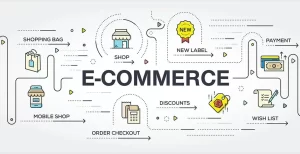
E-Commerce is buying and selling goods and services using electronic media. It has replaced traditional methods of accounting, inventory control, money transactions, and management with efficient digital systems.
Types of E-Commerce
Business-to-Business (B2B)
This is a type of e-commerce in which business organizations sell products or services to other business organizations through electronic media such as the internet. In this system, transactions usually involve large quantities and long-term business relationships. Examples include manufacturers selling raw materials to wholesalers or software companies providing services to other companies.
Business-to-Customer (B2C)
This is a form of e-commerce where businesses sell products or services directly to individual customers online. It is the most common type of e-commerce and allows customers to shop easily from home. Online shopping platforms like Amazon, Flipkart, and Daraz are popular examples of B2C e-commerce.
Digital Middleman
This is an online platform that acts as an intermediary between buyers and sellers. It does not usually own the products but helps connect sellers with customers and facilitates transactions through secure payment systems. The digital middleman earns income through commissions or service charges. Examples include eBay, OLX, Uber, and Airbnb.
E-Business: Running Businesses Online Efficiently
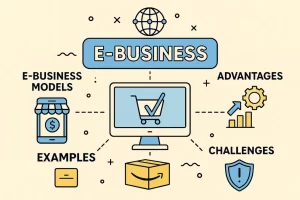
E-Business involves performing business activities using the internet, including buying, selling, servicing customers, and collaborating with partners. Some popular examples of E-Business are Amazon, eBay, and Alibaba, etc.
Advantages of E-Business
- Worldwide Presence
- Cost-effective marketing and promotions
- Better customer service
- removes location and availability restriction
- gives a competitive advantage
- cuts communication and telephone costs
Disadvantages of E-Business
- Requires a reliable internet connection
- Security and privacy risks
- Lack of personal contact with customers
- Technical problems and system failures
- High initial setup and maintenance costs
- Dependence on technology
- Legal and regulatory issues
- Not suitable for all types of products
- Trust issues in online transactions
- Requires skilled technical staff
E-Governance: Smarter, Faster & Transparent Government
E-Governance is the use of electronic media to deliver government services efficiently. It helps governments reach remote and rural areas, improve transparency, and reduce corruption. It is an application of information and communication technologies for interaction among government, citizens, and business, as well as in internal government operations to simplify and improve governance.
Objectives of E-Governance
- Support, simplify, and collect government, citizen, and business.
- Improve the delivery of services and the empowerment of people through information.
- Efficient transaction and latest information to businesses about global and domestic markets,
- All-time availability of information and knowledge to policy makers for taking correct and speedy decisions related to grassroots developments.
- Overall enhancement of the efficiency and effectiveness of the government process.
- Adopting a bottom-up, low-cost solution for effective implementation.
Models of E-Government
- G2C (Government to Citizens)
- G2E (Government to Employees)
- G2G (Government to Government)
- G2B (Government to Business)
Challenges of E-Government
- Lack of IT literacy
- Poor coordination
- Need for training
- Weak IT policies
Importance of E-Government
- Improves civil service efficiency
- Encourages public participation
- Creates a healthy business environment
- Enables easy information sharing
Advantages of E-Government
- Speed: E-Government increases the speed of government work by using electronic systems, reducing delays and manual processing.
- Saving costs: It lowers administrative and operational costs by minimizing paperwork and reducing the need for physical offices.
- Transparency: Government information and services become open and easily accessible, helping citizens track processes and decisions.
- Accountability: Digital records make government officials more responsible for their actions and reduce the chances of corruption.
- fast, effective, and efficient service: Public services are delivered quickly and accurately with less effort through online systems.
- Exercise of Fabric Democracy: Citizens can directly participate in governance through online voting, feedback, and public discussions.
Disadvantages of E-Government
- Loss of Interpersonal Communication: Direct face-to-face interaction between citizens and government officials is reduced.
- High Setup Cost and Technical Difficulties: Implementing e-government systems requires high investment and faces technical issues like system failure and maintenance problems.
- Illiteracy: People who are not educated or lack digital skills find it difficult to use e-government services.
- Cybercrime / Leakage of Personal Information: Online systems are vulnerable to hacking, data theft, and misuse of personal information.
- Privacy and Misrepresentation of Information: Personal data may be misused, and incorrect or misleading information can be shared intentionally or unintentionally.
E-Medicine: Technology Saving Lives

E-Medicine (E-Health) is a vital service of E-Government that uses technology for medical diagnosis, treatment, research, and consultation. Some examples of E-Medicine include X-ray, CT Scan, MRI, Online medical consultation, and Health monitoring systems.
Advantages of E-Medicine
- Medical services reach remote areas
- Drones can deliver medical supplies
- Remote counseling is possible
- Advanced tools diagnose critical diseases
Virtual Reality (VR): Experiencing the Digital World
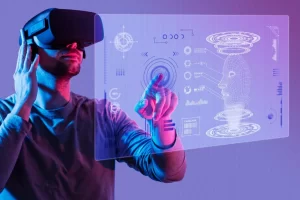
Virtual Reality creates a computer-generated environment that feels real. It is widely used in entertainment, aviation, space research, and training. On a computer, virtual reality is primarily experienced through two of the five senses: sight and sound.
The simplest form of VR is a 3-D image that can be interactively at a personal computer, usually by manipulating keys or the mouse so that the content of the image moves in some direction or zooms in or out.
Virtual Reality can be divided into:
- The simulation of a real environment for training and education
- The development of an imagined environment for a game or interactive story.
VR Devices
- Head Mounted Display (HMD)
- BOOM (Binocular Omni-Oriented Monitor)
- CAVE (Cave Automatic Virtual Environment)
Advantages of Virtual Reality
- Realistic Experience: Provides an immersive and lifelike environment that feels close to the real world.
- Safe Training Environment: Allows users to practice risky activities (such as flying or surgery) without real-world danger.
- Effective Learning Tool: Improves understanding through interactive and visual learning.
- Cost Saving: Reduces expenses related to physical training setups and materials.
- Used in Multiple Fields: Widely used in education, entertainment, medicine, aviation, and space research.
- Better Visualization: Helps in designing, simulation, and planning by visualizing complex structures and processes.
Disadvantages of Virtual Reality
- High Cost: VR devices and systems are expensive to develop and maintain.
- Health Issues: Prolonged use may cause eye strain, dizziness, or motion sickness.
- Technical Limitations: Requires high-performance hardware and stable software.
- Limited Accessibility: Not affordable or accessible to everyone.
- Isolation: Excessive use can reduce real-world social interaction.
Applications of Virtual Reality
- Education and Training
- Entertainment and Gaming
- Medical Field
- Aviation and Military
- Architecture and Engineering
- Tourism
Robotics: Machines That Assist Humans
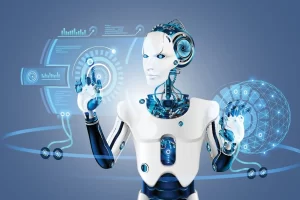
Robotics is a branch of engineering and science that includes electronics engineering, mechanical engineering, computer science, and so on. This branch deals with the design, construction, and use to control robots, sensory feedback, and information processing.
Robotics deals with designing and using robots for various purposes. The term “robot” was first introduced by Karel Čapek in 1920. Robots are especially useful in high-risk environments.
Applications of Robotics
- Surgery
- Bomb disposal
- Space exploration
- Transportation
- Hazardous industrial work
- Commercial purpose
- Hospitality management
Artificial Intelligence (AI)

Artificial Intelligence (AI) is a branch of computer science that focuses on creating machines capable of performing tasks that normally require human intelligence, such as thinking, learning, reasoning, decision-making, and problem-solving. Unlike traditional computers that only follow instructions, AI systems can learn from experience and improve over time.
Branches of AI
- Machine Learning: Enables machines to learn from data
- Natural Language Processing (NLP): Understanding human language
- Expert Systems: Decision-making systems based on knowledge
- Robotics: Designing intelligent robots
- Computer Vision: Understanding images and videos
- Neural Networks: Mimics human brain functioning
Applications of AI
- Medical Diagnosis: AI helps doctors detect diseases by analyzing medical data, scans, and reports accurately and quickly.
- Robotics: AI enables robots to perform tasks intelligently, such as surgery, manufacturing, and hazardous operations.
- Game Playing: AI systems can play games by analyzing strategies and making intelligent decisions (e.g., chess, video games).
- Speech and Face Recognition: AI identifies human speech and facial features for security, authentication, and communication purposes.
- Virtual Assistants (Siri, Alexa): AI-powered assistants understand voice commands and help users perform daily tasks.
- Fraud Detection: AI detects unusual patterns in transactions to prevent financial fraud.
- Autonomous Vehicles: AI allows self-driving vehicles to sense their surroundings, make decisions, and drive safely.
Cloud Computing

Cloud computing is a technology that provides computing services such as storage, servers, software, and databases over the internet instead of using local computers or physical servers.
Deployment Models
- Public Cloud: Services available to everyone (e.g., Google Cloud)
- Private Cloud: Used by a single organization
- Hybrid Cloud: A Combination of public and private clouds
- Community Cloud: Shared by organizations with similar needs
Service Models
- IaaS (Infrastructure as a Service): It provides access to fundamental resources such as physical machines, virtual machines, and virtual storage.
- PaaS (Platform as a Service): It provides a run-time environment for applications, development and deployment tools, etc.
- SaaS (Software as a Service): It allows users to use software applications as a service, like Gmail.
Advantages of Cloud Computing
- Cost-effective
- Scalable and flexible
- Easy access from anywhere
- Automatic updates
- Data backup and recovery
Purpose of Cloud Computing
- Store data online
- Share resources efficiently
- Reduce IT infrastructure cost
- Improve collaboration
- Provide fast and reliable services
Big Data
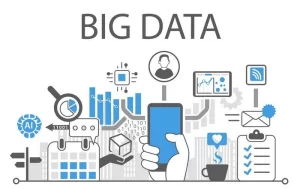
Big Data refers to extremely large and complex data sets that cannot be handled by traditional data processing systems.
Types of Big Data
- Structured: Databases, tables, transaction and financial records,
- Unstructured: Videos, images, social media posts, text, documents.
- Semi-structured: Emails, XML files, web server logs.
Characteristics of Big Data
- Volume: Large amount of data
- Velocity: Speed of data generation
- Variety: Different data types
- Veracity: Data accuracy
- Value: Useful insights
Sources of Big Data
- Social media
- Sensors and IoT devices
- Online transactions
- Mobile applications
- Websites and logs
Advantages of Big Data
- Better decision-making
- Improved customer experience
- Cost reduction
- Predictive analysis
- Business growth
Disadvantages of Big Data
- Data security risks
- High storage and processing costs
- Complexity in data management
- Privacy concerns
- Requires skilled professionals
Mobile Computing
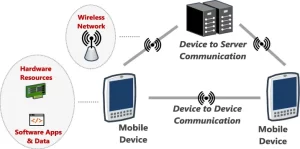
Mobile computing allows users to access data and applications anytime and anywhere using mobile devices and wireless networks.
Advantages of Mobile Computing
- Portability
- Easy communication
- Real-time data access
- Increases productivity
- Supports remote work
Disadvantages of Mobile Computing
- Security threats
- Limited battery life
- Network dependency
- Small screen size
- Data loss risk
Internet of Things (IoT)
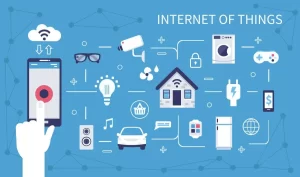
IoT is a network of physical devices connected to the internet that collect and exchange data. This is the globally ruling technology acting as a ley to shrink this whole universe to a tiny globally connected village.
Advantages of IoT
- Automation and efficiency
- Real-time monitoring
- Time and cost saving
- Improved decision-making
- Smart resource management
Disadvantages of IoT
- Security vulnerabilities
- Privacy issues
- High setup cost
- Technical complexity
- Dependence on the internet
Applications of IoT
- Smart homes
- Healthcare monitoring
- Smart cities
- Agriculture (smart farming)
- Industrial automation
- Wearable devices
Thank you for visiting Recent Trends in Technology
Also, click here for more notes
